
Have you ever wondered why you feel instantly drawn to someone even before they’ve spoken a word? That sudden pull, that magnetic feeling, isn’t random. It’s the result of deeply embedded psychological, biological, and social forces shaping your perception in real time. Understanding how attraction works according to psychology can help you make sense of your own connections, relationships, and even your patterns of who you choose to love.
Attraction isn’t simply about looks. It’s a complex, continuously updating process involving brain chemistry, lived experience, shared values, and emotional responsiveness. In this article, we break down the science of attraction from key theories and types to the psychological mechanisms that drive it.
What Is Attraction in Psychology?
In psychology, attraction is defined as a positive evaluative response toward another person a force that pulls us toward them emotionally, physically, or socially. It is not the same as love or lust, though all three can overlap. Attraction is better understood as the foundation the initial and ongoing process that makes us want to be close to someone.
Researchers broadly identify three types of interpersonal attraction: physical attraction (based on appearance), social attraction (based on personality and likability), and task attraction (based on competence and working ability). Importantly, attraction is a two-way, continuously updating process the more you connect with someone emotionally and in conversation, the more attractive you tend to find them.
Types of Attraction According to Psychology
Psychologists have identified multiple types of attraction that extend well beyond the physical. Each serves a distinct psychological and relational purpose.
Physical Attraction
Physical attraction is based on appearance, body language, facial symmetry, and non-visual cues. It is often instant and triggers physiological responses dopamine and norepinephrine are released in the brain, activating the orbitofrontal cortex, the region that processes sensory rewards. Evolutionary biology plays a strong role here: physical cues like symmetry, BMI, and waist-to-hip ratio can signal reproductive fitness and health.
Emotional Attraction
Emotional attraction is the desire to connect based on someone’s personality, depth, and inner qualities. It tends to be deeper and more enduring than physical attraction, forming the backbone of long-term relationships.
Romantic Attraction
Romantic attraction is the desire for a romantic partnership holding hands, going on dates, building a shared life. It is distinct from sexual attraction: you can feel romantic attraction toward someone without feeling sexual desire, and vice versa.
Sexual Attraction
Sexual attraction is driven by the desire for physical or sexual intimacy. It is influenced by both biological factors (hormones, pheromones) and psychological ones (personal history, relationship context).
Intellectual Attraction
Intellectual attraction sometimes called “sapiosexuality” when intense is being drawn to someone’s mind: their ideas, curiosity, and the way they think. Many people report this type of attraction deepening over time, especially in long-term partnerships.
Aesthetic Attraction
Aesthetic attraction means appreciating someone’s beauty the way they dress, move, or carry themselves without necessarily wanting a romantic or sexual relationship with them. It is common in art, admiration, and non-romantic friendships.
The Psychology Behind How Attraction Works
Several core psychological mechanisms explain why we feel attracted to specific people. These aren’t conscious choices they operate quietly, beneath the surface of everyday interaction.
The Mere Exposure Effect (Proximity)
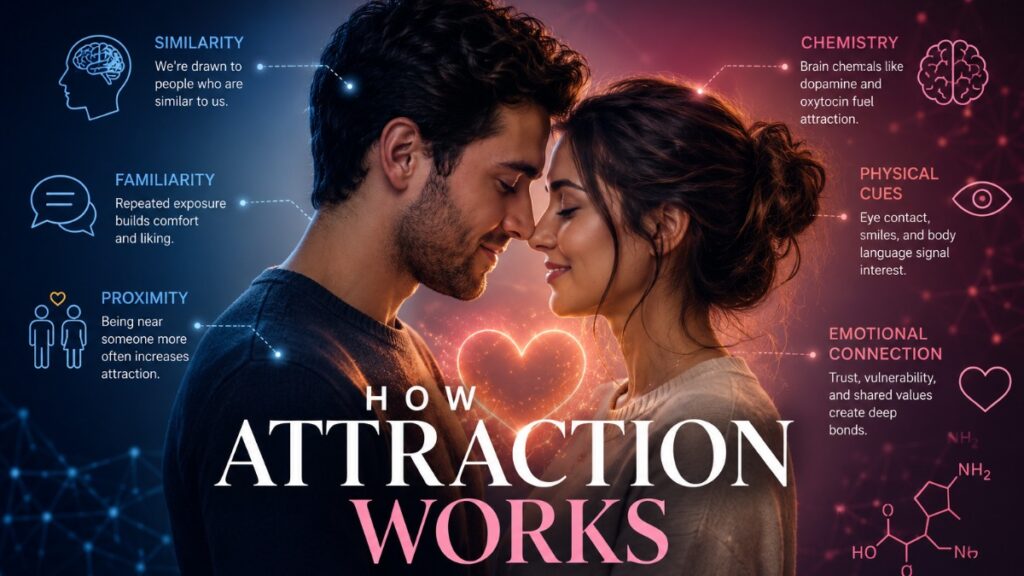
One of the most well-documented phenomena in attraction research is the mere exposure effect: the more often you encounter someone, the more likely you are to feel attracted to them. Robert Zajonc formally coined this principle in 1968 after a series of experiments showing that repeated exposure to any stimulus including people consistently increases liking. The brain categorizes familiar stimuli as safer and more pleasant, often without conscious awareness. This is why office romances, friend-group relationships, and neighbourhood love stories are so common proximity creates the condition for attraction to grow.
Importantly, Zajonc found that the effect operates subconsciously you don’t need to remember previous encounters for familiarity to influence your feelings. The effect tends to peak within 10–20 exposures, after which repeated contact may plateau or even slightly decline.
The Similarity-Attraction Effect
We are overwhelmingly drawn to people who share our beliefs, values, and interests. This is called the similarity-attraction effect, and it is considered the most important factor in long-term relationships friendships and romances alike. Boston University research identified a key psychological driver behind it: self-essentialist reasoning. When people believe they have a core inner essence that shapes who they are, they assume others do too and when they spot a shared interest, they infer a deeper shared worldview. The popular idea that “opposites attract” is, in fact, not supported by the evidence.
Reciprocity When They Like You First
Knowing that someone is attracted to you significantly increases your own attraction toward them. This is the reciprocity principle: people tend to like others who like them back, because genuine affection, support, and concern are among the most rewarding experiences a person can have. It creates a powerful positive feedback loop mutual interest breeds more mutual interest.
Misattribution of Arousal
Your brain can confuse non-romantic physical excitement for attraction. In the now-classic 1974 suspension bridge study, Dutton and Aron found that men who were approached by an attractive female interviewer while standing on a high, fear-arousing bridge were significantly more likely to call her afterward and used more sexual imagery in their responses than men on a stable, low bridge. The conclusion: the brain misattributed the physical arousal caused by fear as attraction toward the interviewer. This explains why exciting first dates roller coasters, action films, adventure activities can amplify feelings of attraction.
What Happens in the Brain When You Feel Attracted to Someone?
Attraction is not just an emotion it’s a neurochemical event. When you feel drawn to someone, your brain floods the reward circuit with dopamine (the “feel good” chemical that fuels excitement and motivation), norepinephrine (which causes a racing heart and heightened alertness), and serotonin (which affects mood and obsessive thinking). Oxytocin often called the “bonding hormone” deepens feelings of closeness and trust, especially after physical touch.
Attraction also activates the orbitofrontal cortex, the brain’s sensory reward processing centre, which is why the early stages of attraction feel genuinely pleasurable and even addictive. There is ongoing scientific debate around pheromones chemical signals that may unconsciously influence attraction but while animal studies are robust, human evidence remains mixed.
Key Psychological Theories of Attraction
Reinforcement-Affect Model
This theory proposes that we are attracted not only to people who reward us directly, but also to those we associate with positive feelings. If you first meet someone at a joyful event a wedding, a holiday that happiness becomes psychologically linked to them, increasing attraction.
Social Exchange Theory
Social exchange theory views relationships through a cost-benefit lens: we are most attracted to people who offer high rewards (emotional support, companionship, fun) at low cost (effort, conflict, stress). This explains why people often assess compatibility early consciously or not by gauging how effortless an interaction feels.
Evolutionary Theory of Attraction
Evolutionary psychologists argue that attraction evolved to maximize survival and reproductive success. Physical features like facial symmetry, healthy body weight, and waist-to-hip ratio serve as subtle biological signals of health and genetic fitness. Gender differences in mate preferences such as men’s historically stronger emphasis on physical appearance and women’s on resource availability and reliability are explained through evolutionary pressures, though these patterns are also shaped by cultural context.
Sternberg’s Triangular Theory of Love
Robert Sternberg’s influential model suggests that romantic relationships are built from three components: intimacy (emotional closeness), passion (physical and romantic desire), and commitment (the decision to maintain the relationship). Different combinations of these three produce different relationship types for example, passion + intimacy without commitment is “romantic love,” while all three together form “consummate love.”
Psychological Drivers That Deepen Attraction Over Time
First impressions matter, but lasting attraction is built through behavioural and emotional patterns that unfold over time:
- Warmth and kindness — make people feel emotionally safe; rated consistently high in long-term attraction research
- Self-disclosure — revealing your true thoughts and vulnerabilities closes emotional distance and creates intimacy
- Responsiveness — feeling genuinely heard and understood is one of the strongest predictors of sustained attraction and relationship happiness
- Honesty — creates psychological safety and trust, which deepens emotional and romantic attraction
- Reliability — consistent behaviour over time builds confidence in a person, making them more attractive as a long-term partner
- Growth mindset — we are drawn to people who believe they can improve; potential is itself attractive
Does Attraction Change Over Time?
Yes and significantly. Initial physical attraction, while powerful, tends to fade or stabilize as novelty wears off. What deepens, in successful long-term relationships, is emotional and intellectual attraction built through shared experiences, vulnerability, and consistent responsiveness. Attachment theory adds another layer: people with secure attachment styles tend to develop attraction that grows steadily with trust, while those with anxious or avoidant attachment may experience volatile or suppressed attraction patterns that reflect earlier relational experiences.
How to Understand Your Own Attraction
Understanding your own attraction patterns is a form of emotional self-awareness. Start by identifying which types of attraction you most frequently experience is it primarily physical? Intellectual? Emotional? Then examine whether your attraction patterns align with your values and long-term relationship goals.
It’s also important to distinguish between fleeting attraction (based on novelty or arousal) and meaningful connection (built on reciprocity, similarity, and emotional depth). If attraction feels compulsive, destabilising, or consistently leads to unhealthy relationship dynamics, it may be worth speaking with a licensed therapist to explore underlying attachment patterns or past experiences.
Frequently Asked Questions
Q: What causes attraction according to psychology?
Attraction is caused by a combination of factors proximity (mere exposure effect), similarity in values and personality, reciprocity, brain chemistry (dopamine, oxytocin), and evolutionary instincts. No single factor explains attraction; it is a layered, multi-sensory process.
Q: What are the main types of attraction?
The main types are physical, emotional, romantic, sexual, intellectual, and aesthetic attraction. Each serves a different psychological purpose and can exist independently of the others.
Q: Is attraction just physical?
No. While physical attraction is often the initial spark, psychological research consistently shows that proximity, similarity, reciprocity, emotional responsiveness, and shared values play equally if not more powerful roles in who we find attractive.
Q: Can attraction be one-sided?
Yes. Attraction does not need to be mutual to be genuine. One-sided attraction is psychologically real and can be intense but reciprocity significantly amplifies and sustains mutual attraction over time.
Q: What is the mere exposure effect in attraction?
The more often you encounter someone, the more likely you are to feel attracted to them even without conscious awareness. Robert Zajonc first formally documented this effect in 1968, and it has since been confirmed across hundreds of studies.
Q: What does misattribution of arousal mean?
Misattribution of arousal means your brain can confuse general physical excitement like fear or adrenaline for romantic attraction. The 1974 Dutton and Aron suspension bridge study is the classic demonstration of this effect.
Conclusion
Attraction is one of the most fascinating and complex experiences in human psychology. It is not simply about looks it is shaped by familiarity, shared values, brain chemistry, evolutionary history, and the quality of emotional connection. Understanding the forces behind attraction empowers you to make more conscious choices in your relationships and to build the kind of connection that goes beyond a fleeting spark. Take a moment to reflect: what draws you to the people you’re closest to? You may find the answer is more psychological than you think.
